|
|
|
You can get e-magazine links on WhatsApp. Click here
|
|
|
|
|
|
Viksit Bharat 2047: Increasing India’s agri exports to $700 bn
|
|
Tuesday, 16 December, 2025, 15 : 00 PM [IST]
|
|
Dr Nimisha & Shashwat Pandey
|
For centuries, agriculture has been the backbone of India’s economy, pillar that had defined both livelihood and food security as well as rural development for millions. Viksit Bharat 2047 is the new vision of the nation leading to a blueprint to turn India into an established and competitive nation at par with global yardstick by its Centenary Independence Year in 2047, with agriculture being central. Yet, the manner in which this sector has been transformed from subsistence-based farming to a high-value, technology intensive export-oriented system is a testimony to India’s aspiration to become an important player in world food economy.”
Today, India is one of the world’s leading producers of milk, spices, rice, fruits and vegetables, and seafood. However, its contribution to world agricultural trade is still small, which suggests a great potential remaining to be used. Global demand for food is expected to increase massively by 2050 and as international markets shift towards more sustainable, diverse and value-adding food products, India has an opportunity to further develop into global agro-food supply chains.
It is in this milieu that India has made an ambitious objective of raising agricultural and processed-food exports to a target of US$700 billion by the year 2047. It would require unprecedented coordination of technological advance, policy reform, infrastructure refit, market access, climate-impervious farming and global branding. A further, and perhaps most important outcome would be that it will shift the position of India from a mere producer to an international powerhouse in sustainable, innovative and high-value agriculture.
1. Strengths and Current Momentum
India already has major agricultural advantages. One of the largest producers of rice, spices, milk and horticultural products in the world. The country has seen a spike in the number of agro-tech start-ups, precision agriculture and cold chain infrastructure built in recent years. Indian agricultural, and allied exports have increased to US$52 billion in 2022–23 from US$39 billion in 2013-14 and are expected to grow threefold, according to a PHDCCI report.
The growth trajectory is supported by institutions. APEDA (Agricultural and Processed Food Products Export Development Authority) has played a very significant role: the exports grew from a mere US$0.6 billion in 1987–88 to US$26.7 billion at the finish of FY 2022–23 with its focused interventions.
2. The Global Demand Imperative
Here are some global trends which add to the agreeability of India’s target of US$700 billion. For one thing, food demand is growing fast- Under a business-as-usual scenario, global demand could jump by as much as 56 percent by 2050 (compared with 2010), according to a World Bank–backed systems analysis.
Second, consumers globally want higher quality, nutritious, sustainably produced food. This shift favours exporters with robust biodiversity, smallholder farming and deep traditional knowledge which is exactly where India has an advantage.
At the same time, global trade holds great promise for India - as noted recently by the chairman of APEDA - India’s official agribusiness export agency, “India’s share in world agricultural trade is still low (~2.4 percent), reflecting vast opportunities to increase its presence.”
3. Key Sectors to Power the Export Surge
To hit such an ambitious target, India will need to aggressively scale a few high potential sectors:
- Ready to Cook & Processed: Leveraging value addition to move beyond raw commodities and into global-ready packaged foods.
- Marine & Aquaculture: Products from here are shrimps, tuna and seaweed as well as processed seafood can also be an important source.
- Horticulture: Fresh fruit and vegetable exports especially the exotic fruits & veggies and GI tagged produce will have a significant role.
- Dairy & Animal Proteins: As global demand surges for whey, casein, fermented dairy, and poultry products, India can diversify.
- Organic & Climate-Smart Tag: Millets, herbs, botanicals and organic produce – for health and sustainability-focused markets.
4. Roadmap: Unlocking the US$700 Billion Vision - The strategic levers that must be pulled are:
a) Innovation & Technology - Rely on AI, drones and remote sensing to boost productivity and minimise waste.
- Adopt block chain or digital traceability to give international buyers confidence in the safety, quality and source.
- Climate-resilient seeds and resource efficient farming (e.g. water-saving) may be an area to invest in Food production, Distribution, Nutrition.
b) Infrastructure & Value Chains
- Construct additional export-focused agro-processing hubs and mega food parks.
- Build up cold chain capacity and tie in with ports and shipping corridors.
- To strengthen the laboratory capacity for phyto-sanitary and quality checks.
c) Policy & Market Access
- Free Trade Agreements (FTAs) negotiations to cut Tariffs and NTBs.
- Elevate food safety standards to the best in global markets.
- Promote Indian “superfoods” (example – millets, curcumin) by GI branding and through international marketing.
d) Farmer Empowerment
- Form Farmer Producer Organisations (FPOs), and connect farmers with the export clusters.
- Capacitate farmers on global certification (Global GAP, Hazard Analysis and Critical Control Point- HACCP).
- Direct match between production and international buyers and outlets.
5. Projected Growth Trajectory: Key Export Segments
Below is a projected roadmap for how various agricultural segments might scale up over time to contribute to the US$700 billion goal by 2047.
Segment
|
Estimated
Exports by 2030
|
Projection
by 2047
|
Key
Growth Drivers
|
Processed
& Ready-to-Eat Foods
|
US$
60–70 B
|
US$
250–300 B
|
Value
addition, global convenience demand
|
Marine
& Aquaculture
|
US$
12–15 B
|
US$
150–180 B
|
Shrimp,
tuna, seaweed, processed seafood
|
Cereals
(Premium / GI Rice)
|
US$
15–20 B
|
US$
70–90 B
|
High-quality
rice branding
|
Millets
& Superfoods
|
US$
5–8 B
|
US$
80–100 B
|
Health
markets, UN Millet mission
|
Fruits
& Vegetables
|
US$
15–18 B
|
US$
120–150 B
|
Fresh-cut,
GI fruit, cold chain
|
Spices
& Botanical Extracts
|
US$
10–12 B
|
US$
60–70 B
|
Nutritional
extracts, wellness exports
|
Dairy
& Animal-derived Products
|
US$
8–10 B
|
US$
40–50 B
|
Casein,
whey, fermented products
|
Organic
& Sustainable Products
|
US$
5–6 B
|
US$
30–40 B
|
Organic
certification, consumer trust
|
6. Challenges and Mitigation Strategies 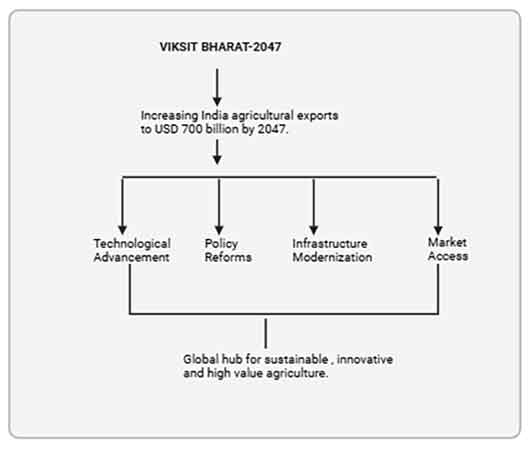 The vision is ambitious, but there are a few obstacles: The vision is ambitious, but there are a few obstacles:
- Quality & Compliance Risks: Adherence to stringent sanitary and phytosanitary (SPS) measures require additional testing capacity, traceability, as well as certification.
- Logistics Bottlenecks: Inadequate cold chain, ineffective ports and poor transport networks bleed perishables.
- Fragmentation among Farmers: Several smallholders and farmers are not necessarily of scale or organised enough to export consistently; FPOs need to be reinforced.
- Climate Uncertainty: Volatile crop yields as a result of erratic weather require investment in trait development and managing resources sustainably.
Mitigation includes leveraging public-private partnerships, scaling up infrastructure investment and focusing on climate-smart agriculture.
7. Global Leadership: India’s Role in the 2047 Food Economy If successful, by 2047 India could be a global food and nutrition innovations hub. It could be the world’s largest exporter of botanicals, millets and functional foods; a leader in marine and dairy value chains; and an exemplar for sustainable, climate-resilient farming.
Beyond volume, India’s impact would manifest in a sustainable food system, ethical sourcing and inclusive global trade.
A target of $700 billion of agricultural exports by 2047 sounds audacious, but it’s well-founded in India’s comparative advantages and global demand patterns, as well as an unequivocal strategic pathway. Achieving this vision will require courageous policy decisions, coordinated infrastructure investments and extensive outreach to farmers. If achieved, Viksit Bharat 2047 will be not only an economic milestone but an example of India’s ability to feed the world in a sustainable and innovative way.
(Dr Nimisha is professor, Amity Institute of Pharmacy, Amity University Uttar Pradesh Lucknow Campus; Pandey is guest faculty at Institute of Pharmaceutical Sciences (LUIPS), University of Lucknow. They can be reached at nsrivastava3@mail.amity.edu)
|
|
|
|
|
|
|
|
|
|